Mama Gone Green is a blog dedicated to raising happy children and reducing our impact on the Earth. My name is Taryn and I am the mother of 2 young kids and an environmental studies instructor at a community college in Portland, Oregon. Please join me as I journey through life as a mama, teacher, knitter, photographer, gardener, and environmentalist!
Showing posts with label book reviews. Show all posts

Saturday, December 19, 2015

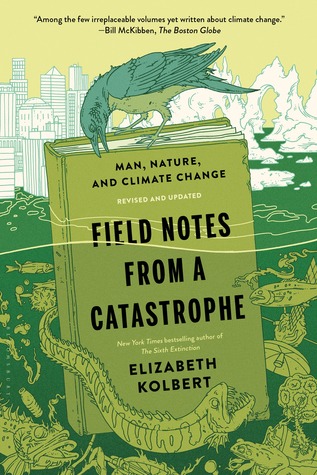
Field Notes From a Catastrophe: A Review

22529404

I recently finished reading Field Notes from a Catastrophe by Elizabeth Kolbert and it was amazing. The book is a wee bit outdated, first published in 2004, I believe, but Kolbert does a fabulous job of explaining the implications of global warming in layman’s terms.
Kolbert writes about melting glaciers, changes in cultures, and species that are going extinct. She talks about the politics surrounding climate change and the  "business as usual" mentality that prevents any real changes in the amount of carbon emissions we are spewing out. She talks about places that have made change... and how little of a difference it makes until the entire world follows suit. She talks about technological fixes that many people are assuming, or at least really hoping, will save us, and the adaptations that will need to start happening very soon if they don't.
I have the revised and updated edition, so there are a few more chapters tacked onto the end which are really just essays that Kobert had already published, but it does give some updates and make the book slightly more relevant.
Either way, I loved this book. It does such a great job of explaining the basics of climate change in a simple and captivating way, and it touches on all aspects of the issue. And as much as the book emphasizes the importance of our current climate situation, it doesn't feel completely doom-and-gloom. This is a perfect book for folks who want to learn about change in a bit more detail, but don't want to be bogged down with scientific jargon and data. Pin It Now!

Friday, November 20, 2015

The Soil Will Save Us: A Review

18050026 

I just finished reading The Soil Will Save Us by Kristin Ohlson. Kristin Ohlson is a local Portland author. It's always fun to read something that was written by someone in your own community, isn't it? Makes it seem just a little more special.
This is a book about climate change. However, it is unlike any other book on climate change that I have read. This book doesn't talk about the demise of the planet, or how we need to all stop driving our cars tomorrow. This book addresses climate change from a new perspective; instead of the doom and gloom, it addresses how we can slow climate change without a lot of money or technology.
The Soil Will Save Us talks about the importance of global soils in sequestering and storing carbon from the atmosphere. And, according to Ohlson's research, a significant amount of our carbon emissions could be removed from the atmosphere by simply growing soil, and leaving that soil (and the microbes that call it home) undisturbed indefinitely.  She talks about the importance of grazing in maintaining soil productivity (not the first that I have read about this in recent months), the need for no-till farming practices, and how political policies that reimburse farmers for the carbon that their soil sequesters may be the wave of the future.
I am a soils nerd, so I, of course, loved the book. My one criticism is that it reads a bit like a novel, which for most, is probably great. However, for me, I felt that there was so much important information being said, yet in my mind I was having trouble compartmentalizing it and figuring out the main points to put to memory. I felt like I needed the chapters to be broken up into different sections, instead of one idea running into the next. Regardless, I enjoyed reading it.
Ohlson's book portrays hope for our future and her belief that we will be saved by the soil. I am not quite convinced enough to be as optimistic as her, but I can only hope that she is right.. and that the word will spread before it is too late. I personally think that in order to mitigate climate change, we will probably have to take action in so many ways on so many levels..... but I must admit that growing soil sound like the best solution I have heard of yet.
I am considering having my class read this next term for their literature review. It might be nice to give them something optimistic for once....
Pin It Now!

Saturday, May 23, 2015

Toxin Toxout: A Review

18404126


Toxin Toxout: Getting Harmful Chemicals Out of Our Bodies and Our World by


Pin It Now!

Thursday, August 7, 2014

The Sixth Extinction


The Sixth Extinction, by Elizabeth Kolbert, is an account of how the Earth's organisms have changed over time. The first half of the book touches on the first 5 mass extinctions (the most famous one being about 65 million years ago, when the dinosaurs were killed off). Kolbert discusses the likely reasons for each of the extinctions, and explains how the course of life becomes completely re-routed as some species die off and other survive to pass along their genes and evolve into new species. She also asks how different life on Earth might be if the extinctions had not happened. Would completely different life have evolved? Would humans still be here?

The second half of the book talks about more recent times- since humans have been on the planet. Humans, even in our earliest days, have had huge impacts on the planet. Our keen minds and our ability to craft tools has caused us to eliminate the majority of the large mammals in existence, most of them likely not on purpose. When our species first evolved, we even managed to kill of the Neanderthals (but not without breeding with them first!).

Current humans are having huge effects on the planet and its biodiversity. Climate change is acidifying the oceans and killing off coral. Our fragmentation of wild habitats, especially in the tropics, is killing off all sort of species, many that we haven't even discovered yet. Invasive species are out-competing endemic species. Pathogens and viruses, like the chytrid fungus and white-nose syndrome, are spreading and killing off entire species.

Most of our impact is unintentional. Most of us aren't trying to harm the planet or cause organisms to face extinction. But, like it or not, people change the world around us. Some of this is good change, and humans across the planet are working hard trying to save species from extinction. But most of our impact is negative. From pollution to resource use, climate change to poaching, humans seem to be the ultimate invasive species that has taken over our Earth.

I really enjoyed this book. Although I didn't whip through it like I had expected, I enjoyed reading each thoughtful chapter, and took time to reflect on what I had read. There are a lot of facts and a lot of science, but the chapters read more as an account of history and not like a textbook. It isn't a doomsday account, and really doesn't even talk all that much about global warming. It is more just a presentation of the evidence that surrounds us. Overall this gets a thumbs up and I think I am going to add this to my student's reading list for next term.


Pin It Now!

Thursday, March 13, 2014

Slow Death by Rubber Duck: A Review

6621894 
I have had this book on my to-read list for awhile. Ever since it came out actually. Deciding to choose a new book for my class to read next term was the motivation I needed to actually get my hands on it and read it. And I'm glad I did.
The book is insanely scary, but also full of humor and easy to read. The book is written by two Canadian scientists who, in order to study how everyday products affect us, purposely try to increase their body burden of several chemicals that are known, or believed, to be dangerous to our health. They expose themselves to phthalates, BPA, mercury, teflon, flame retardants, and probably a couple other things I am forgetting about. They use normal everyday items to expose themselves (like eating tuna sandwiches), but do repeated exposures over a few days. Testing their blood and urine pre and post exposure shows how much they can increase their toxic body burden in a very short amount of time. And, in some cases, that increase is pretty incredible.
I can't say that I learned anything surprising from this book, but I also teach about these things for a living, and sadly, have heard these types of stories before. Nonetheless, the authors do a great job of intermingling history, politics and current science and wrapping it up into a neat little humorous package. The last chapter focuses on some simple ways that you can help your family avoid some of the burden of these everyday toxic chemicals. This is a great read, especially for folks with children at home.
Pin It Now!

Thursday, April 11, 2013

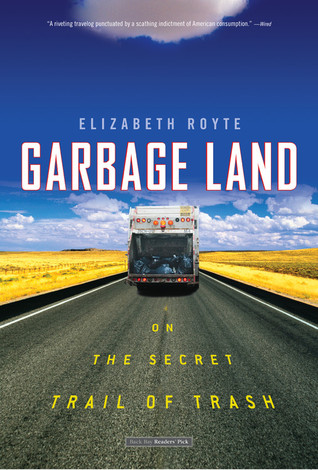
Garbage Land: on the Secret Trail of Trash: A Review


A few weeks ago, I finished up the book Garbage Land: on the Secret Trail of Trash by Elizabeth Royte. The title of this book doesn't quite entice me, but when I came across a synopsis of it, it seemed like it would be a perfect fit for the environmental science class I am teaching this term. Surprisingly, I really enjoyed it. I found it very informative, entertaining, and easy to read. And, it DOES fit perfectly with my class this term and I am having all of my students read it.
Americans produce huge amounts of trash. Yes, some is recycled, but the amount of trash that gets sent to landfills, or incinerated, each day is astounding. And, once we throw it "away", our trash often continues to cause problems for years to come by polluting the land and water.
In Garbage Land, the author follows the fate of her trash from her home in NYC and tries to figure out where it all ends up. This takes us on some crazy adventures form landfills to recycling centers, a wastewater treatment facility, a composting facility, and a whole host of others. Royte is smart and witty, and pokes fun at many of the folks she encounters, which only makes her tale more enjoyable.
Royte has us join her as she sorts through her trash before putting it on the curb. She separates the trash into categories, weighs each category, and deeply contemplates each portion of her trash and where it it originates from. She spends time doing her neighborhood route with the garbage collectors, getting a hands-on feel for the amount and type of trash to be found in NYC. She then tries to track down the landfill where her trash ends up. In the end, she is unsuccessful, but along the way she discusses landfills and some of their common problems, like landfill siting and leachate (basically trash-juice) contamination of groundwater.  As she tries to see the landfills first hand, she starts to discover the politics and secretiveness behind the trash business.
Rote also looks at ways that our "trash" can avoid the dump. She researches composting facilities and even tries her hand at composting her own food waste. She tours a recycling facility and touches on many of the common problems with recycling and why it is not as efficient as it could be.  She writes about hazardous waste and the ways that we deal (or don't deal) with it. She has a whole chapter devoted to plastics and how terrible they are for the planet, including some reasons why plastics aren't as recyclable as most folks think.
Royte doesn't stop at her trash can waste either... she decides to follow the path of her toilet waste. She visits the waste water treatment facility and sees how they separate the solids out, treat them, and then sell them as a fertilizer. This practice is commonly done across the country (including here where I live). These biosolids do have lots of nutrients, but they also often contain heavy metals and other toxic substances.
She ends the book discussing ways that we can reduce our trash, and subsequently, our impact on the Earth. She talks about reducing our consumption, ending junk mail delivery, avoiding packaging, and eventually aiming for zero waste communities.
The sad part is that yes, we are guilty of consuming too much, but so much of this lies in the hands of product manufacturers...most products these days are not built to last. In fact, the designers include "planned obsolescence" into the design....they figure out how quickly they can make something break so that you still trust them enough to buy a new one. In other words, our "stuff" is only meant to last a few years (and that is how these corporations keep making so much money!). Companies should have to take back their "stuff" after it breaks and figure out how to recycle it. One of the most important things I have really learned lately is that we vote with our dollars. When you can, give your money to folks who are making products with care and making them to last years or generations, not big corporations who are making stuff that is destined for the dump.
I would definitely recommended this book. It is such an interesting and thought-provoking journey about what we "get rid of" and where it actually goes. Pin It Now!

Thursday, August 9, 2012

Our Stolen Future: A Review

Our Stolen Future by Theo Colburn, Diane Dumanoski and John Peterson is an amazing and amazingly depressing book. First published in 1996, it is a bit outdated, but it is an extremely important piece of work.
The book discuss, in detail, the connections between made-made hormones (from pesticides, medicines, plastics, and more) and human health issues, specifically fertility. At the time this book was written, this was cutting-edge science, and was essentially a more modern version of A Silent Spring. And maybe even a scarier version. But yet this book doesn't seem to have made a dent in the way we think about chemicals. In fact, our public library (which is awesome, mind you) didn't even have a copy of this book. There was one lone copy at the community college library that I teach. The work of Theo Colborn (one of the authors) has been featured in several films that discuss connections between the environment and human health... but this stuff should have been front page of every newspaper.
Our Stolen Future traces the connections between synthesized chemicals in our environment, declines in populations of wild animals, and health and fertility issues in humans. It shows how certain types of chemicals get stored in fat cells of organisms that ingest them. The organism who ingests them may not show any ill effects, and so when safety tests on these chemicals are run, they seem safe and are given a green light. It is years later, however, that these chemicals can start to take their toll. The chemical burden of a mother can interfere with the development of her babies.... causing things like lowered sperm counts in male offspring, higher chance of certain cancers in babies, and incorrectly developed sex organs.
We are seeing similar patterns in wild animals, and often to higher degrees. Populations that are already threatened by habitat loss or overfishing and are now being exposed to our chemical poisons are having trouble producing future generations. Lab studies have shown numerous chemicals, that are now ubiquitous, that are shown to greatly reduce fertility in animals. Humans take longer to show these effects because we wait longer to reproduce, but they are showing up. Male sperm counts have been on a rapid decrease over time, miscarriages are on the rise, as are other developmental problem such as ADD, autism, and learning disorders.
In essence, we are messing up the human population. The chemical burden that we are putting into our environment (and therefore into ourselves and our offspring) is starting to take it's toll. It may not be an easy correlation to see..... if we ingest trace small amounts of pesticides on our food, it is unlikely that we would suddenly get extremely sick. And we ourselves may never get sick at all. But our children may. They may suffer learning problems, cancers or infertility. But because these problems result so many years later, and because we are all exposed to so many chemicals, it is hard to tease out which chemicals are doing what.
This is a captivating read, and I made it through the 250 pages in just a few short days. Depressing, yes, but also inspiring. A must read for anyone interested in the connections between chemicals and human health.

Pin It Now!

Wednesday, August 1, 2012

The Homemade Home: A Review


Sania Pell's The Homemade Home is a sweet and inspirational book full of thrifty ways to perk up your home. From creative curtains to embroidered pillows, decorated pots to easy artwork, there is something in this book for just about everyone. Although some of the ideas are very easy, requiring nothing more than tape and scissors, many of the projects do require that you have a sewing machine and know how to do some basic sewing.
Our home is very tiny, and there is not room for anymore pillows, lamps, pots, or most of the fabulous ideas in this book, so there are many great projects that I don't think I will be trying anytime too soon. But I fell in love with her embellished curtains (pockets and all) and hope to re-vamp the curtains in the kids room sometime soon. She also has great easy ideas for bath salts, lavender pillows, and covered notebooks... I think I may know what my family is getting for Christmas this year!
This book is definitely worth a peek. She also has a homemade home for kids that I am hoping to get my hands on. Our library doesn't have a copy, so I think I may have to put that one on my birthday list!

Pin It Now!

Thursday, July 5, 2012

Blessed Unrest: A Review

Howdy! The kids and I got home from our trip to Chicago earlier this week and have been busy unpacking and adjusting to life back in Portland. I have been completely neglecting my blog, but hope to share some picture from our Chicago trip with you soon.
And, in the meantime, here is a brief book review that I wrote a few weeks ago and haven't yet had a chance to post.
Hope you all had a wonderful 4th of July!


Blessed Unrest, by Paul Hawken, is an account of the environmental movement; it's beginnings, it's challenges, it's victories, and the distance it still needs to cover. Although this is a very important book, especially for someone like me who teaches environmental science, I found it hard to get through. True, I am not a fan of reading about history, and I guess the history of the environmental movement falls into that same category.
Hawken's writing is actually quite beautiful, full of metaphors and poetic paragraphs. And, parts of the book I found just absolutely fascinating. I think for me, it wasn't organized in a way that I could easily wrap my head around... the book was written in a mostly linear fashion, but then past strife was related to present day issues and then it would shift back to the past. The book sort of meanders through the history of the environmental movement, covering a lot of ground (because it has to!), but for me, that made it hard to become involved in the book and to be drawn in to reading more than a few pages at a time. So, it took me several weeks to get through this book, despite it being relatively short.
Blessed Unrest is full of important and pertinent information, incredible stories, and amazing facts. It is important to have a history of this movement, a movement that is still happening and gaining speed. It is important to see where we came from and see the direction in which we are headed, and I appreciate Hawken's work and the time and energy it took to compile all of this information. I believe this is a significant work, and I wish that I had enjoyed it more as I was reading it. I think this book is one that I may revisit, in another head-space, and see if a second run provides a more coherent and connected work. Pin It Now!

Monday, June 25, 2012

The Urban Homestead: A Review

The Urban Homestead: Your Guide to Self-Sufficient Living in the Heart of the City by Kelly Coyne and Erik Knutzen is 318 pages packed full of wonderfully inspiring information. The book started out with a section on home gardening, and honestly, I was a little bored. Not that it was bad, but I have just read several books on a similar topic and I already do quite a bit of gardening at home. So reading about it wasn't thrilling, and although there were a couple of snippets of new information (like that families of plants use up different nutrients at different rates), but mostly, it was a lot of information that I am already living and breathing.
However, towards the middle of the book there was a section entitled "Revolutionary Home Economics" that I found chock full of great ideas. Some of their preservation techniques that I really want to try include lacto-fermentation, pickling, making vinegars, making ricotta cheese, homemade butters, and country wines (like dandelion wine). There is also an entire section on water and power, both how to reduce your consumption and how to get your own. I thought it was pretty inspiring.
As an overall package, this is probably the best intro to homesteading book that I have read, especially because it is for urbanites (like myself, at least until we can move to a farm!). The ideas in this book are really practical for someone living on a small plot of land. I think that anyone trying to start their own mini-homestead in the middle of a city should get their hands on this one and give it a read. I know that I will be putting it to some use this summer! Pin It Now!

Tuesday, May 22, 2012

Explore Spring: A Review

Explore Spring by Maxine Anderson is a book geared towards elementary age children and is full of tidbits and activities surrounding the changes that come along with spring. Topics include how the tilt of the Earth creates the seasons, the sprouting and growth of plants, trees, animal migrations, spring babies and weather. Although many of the topics in here are a bit too advanced for Finn (age 4 1/2), there is also plenty that he is interested in. He wanted me to read him the section about tornadoes, and then later that day I heard him explain how tornadoes form to his friend. So cute!
Several of the activities also seem perfect for kids of any age. A few I want to try are carnation dying (have them drink colored water), making a cloud inside a jar, and making a wind chime. Since I am teaching Finn's preschool this week, I just may try and incorporate a few of those into the "lesson plan" (which is mostly playing).
This book is a definite worthwhile check-out from your local library, especially for kids age 7-10ish. I only wish they had one for summer, when we will have plenty of time for explorations! Pin It Now!

Tuesday, April 24, 2012

World Without Fish: A Review

World Without Fish by Mark Kurlansky is a young adult book about the destruction that is happening in our oceans and the depletion of fish on a global scale. I grabbed this book on a whim one day as I passed by it at the library. One of the environmental science courses I teach talks a lot about the decline of ecosystems, including oceans, and the problem of overfishing in general. And, as a vegetarian who eats fish, I know that I am contributing to this overfishing problem. So, I thought it couldn't hurt to learn a few more of the details on this subject.
The book is interesting as the author is an ex-fisherman, and so he knows the topic from a point of view that most scientists don't. And, as an ex-fisherman, he doesn't think that stopping fishing is the solution to the overfishing problem.. instead he focuses on a more sustainable, monitored approach to fishing.
Being a young adult book, it was easy and quick reading. The author did a great job of breaking up the book into topics... like the beginning of the fishing industry, the politics behind fishing, sustainable fishing, pollution and global warming. Each chapter was long enough to explain the topic in depth, without boring the (assumed to be young) reader with too many details. Excellent for the young budding scientist!
Despite the fact that this is a book for young readers, and I was already quite familiar with the subject, I still learned quite a bit from this book. Until reading World Without Fish I hadn't really made the connection on how overfishing is also messing up the lives of other non-oceanic species (like certain birds who depend on fish being forced to the ocean surface by predatory fish) and even the within-ocean connections, like the fact that dolphins depend on blue-fin tuna to find food. Everything on our planet is connected, and you can't simply exterminate one species without it having a cascade effect through the food chain.
This is a great informative book for youngsters who are ready to get involved with environmental issues, or a great easy read for adults who want to learn more about the decline of our fisheries. Pin It Now!

Sunday, April 15, 2012

Having Faith: A Review

Having Faith, by Sandra Steingraber is an amazing book. The entire time I was reading it, I kept asking myself why I hadn't read it already. Published in 2001, it is already slightly outdated, but to me it felt like the modern day Silent Spring.... this is a book that is disturbing, depressing, and inspiring.. a call to action for all of us parents out there. Except, unlike Silent Spring, it doesn't seem like this book motivated much action. I guess in this day and age, folks are sick of hearing about everything that is poisoning us, giving us cancer and slowly killing our planet. I think we have started to feel frustrated that we have no control over our environment and so for most, it is easier to just try not to think about it.
Steingraber is an ecologist who becomes pregnant when she is 40-ish (after winning a battle against cancer in her earlier years). The book documents her journey through pregnancy, as well as her days of nursing her little daughter, but does so from her point of view as an ecologist. She explores the relationships between pesticides and other chemicals that a mother is exposed to and physical or developmental issue that commonly occur in children.
This book really hit home to me, as 2 of the physical issues she speaks of were problems that Finn was born with. The first is un-descended testicles. When Finn was about 8 months old, he had to have surgery to pull one of his testicles, which had not descended, into place. Having Faith talks about the correlation between this problem and the mother's exposure to pesticides during the first few months of pregnancy. Finn was conceived in March (or sometime near March) in Montana, in a small town just west of Missoula, where plenty of land around us was used for farming. The water we drank was groundwater that could easily have been contaminated with pesticides sprayed on the local farms.
The other issue is Finn's teeth. His 4 back molars are missing a lot of their enamel (the enamel is discontinuous around the teeth, which leaves about half of each tooth surface completely vulnerable to decay). Steingraber's book shows an association with this issue (which I had never even heard of before Finn was diagnosed with it) and the mother's exposure to dioxins, which are a by product of industry (PVC manufacturing is one big source).
I can say that this book did make me feel a bit guilty, knowing that these issues that Finn will deal with for his entire life are likely a result of chemicals that I was exposed to before he was even born. But, on the other hand, I only have so much control of my life. I don't spray pesticides (and try not to even eat food grown with pesticides), and I certainly don't produce dioxins (which are a by product of PVC production, among other things).. yet, I am exposed to these chemicals whether I like it or not, just by breathing air and drinking water. But, like Steingraber says, this isn't an issue of mothers not making good decision while pregnant or nursing, but rather an issue of the government not protecting its citizens.
Having Faith also talks about breast milk, the magical-like qualities it has, the perfect balance of nutrients, the antibiotics... in essence, everything a newborn needs. Yet, because of biomagnification through the food chain, breast milk is also one of the most toxic substances known to man. This is something that is wrong at the most very basic level, and something that needs to be changed.
Every time I have nursed little Miss P since reading this book, I have watched her sweet face, and her tiny hands that play with her hair while she nurses, and wonder just how many chemicals I am pumping into her sweet body at that very moment. Something so little and so tiny and so innocent, and yet she is being dosed with poisons. How can we be OK with this?
Having Faith is an amazing book and one that everyone should read (however, I would not recommend reading it while pregnant, because I think it would have stressed me out-- even reading it while nursing was a bit distressing). I just can't figure out why this book didn't cause more of a stir? Why aren't we, as mothers and parents, fighting for the right to have a pregnancy free of chemical exposure? Why aren't we demanding for breast milk that is 100% safe for our babies? So read this book and be inspired. Let's make this world safe for our babes, yes? Pin It Now!

Tuesday, March 27, 2012

Eaarth: A Review

Eaarth: Making  a Life on a Tough New Planet by Bil McKibben, is one of the scariest and one of the most inspirational books I have read in a while. This book is about climate change. The climate change that is already happening, and the climate change that is going to continue to happen. McKibben talks about how we have already surpassed the amount of atmospheric CO2 that our planet can safely handle (350ppm) and how that is continuing to rise. He demonstrates the changes that are happening, from droughts to hurricanes, storms to pest damage....and things are not going to get better, they are going to get worse. We are still spewing huge amounts of greenhouse gases into the atmosphere, and even if we did stop all emissions, right this instant, the planet would still continue to warm for many years to come.
McKibben addresses many of the problems that are going to arise in the not-so-far-away future: climate refugees, people starving, homes and land lost, diminishing water resources, floods and natural disasters. It's too late for us to fix things by installing a few solar panels and taking the bus once a week. The problems are way beyond that and will take a total revamping of our mentality and our society for the needed change to happen. The facts are simply depressing, and many times throughout the first half of this book I felt so terrible for my children because this is the future that I am passing along to them. They will be in the thick of it, and who knows what the future will hold for them. This is some seriously scary stuff. All so important to be reading, but really hard to come to terms with. When they say the truth hurts, I think this is what they meant.
Fortunately, halfway through the book, McKibben's writing takes a turn, and he starts to talk about what can be done. How we can (and will need to) change and shows some great optimism in how the human race can do this. There are going to be bumps and challenges, and life is going to be tough, be there is hope for a future. And the sooner we act, the better.
I was actually brought to tears at the end of this book when the author talks about the power of everyday people to make change. A few small steps can really push policy and the future into a new direction. But, this is about the people demanding change. The people being willing to curb our growth in exchange for the possibility of a less-bleak future. Cutting our emissions so that our children may enjoy some of the luxuries (like electricity and running water) that are so common in this day and age.
This book really made an impact on me, and despite how depressing the first half was, I feel like it is such an important topic. It's uncomfortable to read because it is the truth.. a truth that we do not want to face and a truth that we are mostly avoiding. I have decided to have my class next term read this book for the class literature review; I feel like it is a book that everyone should have to read, to remember and to act on.
Want to get involved? Check out www.350.org, Bill McKibben's global movement to solve the climate crisis. You can sign up for update, start an event in your city, and hear more about the truth. Pin It Now!

Thursday, March 15, 2012

Eating Animals: A Review

Eating Animals by Jonathan Safran Foer is a non-fiction book that punches you right in the guts. It gets right down to the nitty-gritty (and mostly nasty) that is involved with the consumption of animals, especially factory farmed ones. It is brutally truthful, with no holds barred. And it is intense.
The reason why I decided to read this book is that I had read Everything is Illuminated, a work of fiction, also by Foer, and decided I wanted to give another book of his a go. Boy, I had no idea what I was getting into.
As a book, I found this a tremendously powerful read, full of facts, but also compelling and interesting. However, it was not easy to read this book; the graphic details about the horrific truth made it too much to take sometimes. It literally brought me to tears more than once, almost made me vomit, and made me question the sanity of the entire human race.
I first became a vegetarian right when I went away to college. It was a combination of reading Diet for A New America and seeing the "grade D meats: for prisoner and institution use only" stamped on the boxes of food in the CU dorms.  I was actually a very strict vegetarian for about the first 10 years, and then have wavered back and forth between a vegetarian and a mostly-vegetarian, to a baconatarian, or whatever seemed to suit me best at the moment. In recent years, I have mostly not eaten meat, but have eaten it when dining with other meat-eaters (trying to be less demanding). In recent months, I have been shifting back towards eating less meat and had come to a point where I had decided that I was going to be vegetarian again, at least for awhile. And then I read this book and I decided that meat eating was not anywhere in my near future.
This book touched on why we eat animals and why we eat the animals that we do (like, for instance, why is it normal to eat pigs, but not dogs?). Foer gets into talking about confined feedlot operations, the huge impact of animal farming on the environment, and especially global warming, and the terrible terrible treatment that these animals undergo. And not just the ones raised for meat, either. The ones raised for milk and eggs as well. In the US, farmed animals produce 130 times as much poop as the human population of the US. Gross.
Foer also touches on the tons of antibiotics used in animal farming, which are making diseases immune to them, the potential threat of a pandemic from diseases mutating from the animals we raise for food, and the fact that the animals raised for food have been so genetically altered that they are very little like their counterparts found 100 years ago.
The portions of this book that really spoke to me the most were the stories of the animal cruelty: the beatings, the inhumane practices, the deaths without dignity. It made me sick to my stomach to hear the ways in which these animals were treated. On a regular basis. And, fish included. Even wild-caught ones. It made me realize that we need to demand better conditions for the animals that we eat. Whether we do this by voting with our dollars, and only purchasing meat raised from non-factory farms, or we demand change at the policy level makes no difference to me or the animals, but clearly, something has to be done.
After reading this book, I decided to re-instate my vegetarianism and am now questioning the fish that I enjoying eating so much. I have tried go vegan before, several times, and have had a terribly hard time with it, but I would like to reduce the amount of dairy that I consume. We have always purchased milk without growth hormones and 'cage-free' eggs, but after reading this book, I really question what that means. I want to go to the farm where my food is coming from and see their animals. I want to make sure my cheese is coming from a cow that is having a decent life. But how feasible is that? Especially when my husband loves meat about as much as he loves me and my son eats cheese on top of his cereal (no, I am not joking). My family enjoys animal products. A lot. And so my family decisions need to have other peoples thoughts and feeling included.
I think my best bet is to head to my local farmers markets and try to purchase animal products from growers that are not keeping their animals in confined conditions. But what about those mid-week runs to the store for more milk and cheese? Luckily, New Seasons, our local organic grocery, does a pretty good of researching the farms where it buys it food. Now I just need to do a better job of informing myself.
This is a read that I would recommend to those questioning a move towards vegetarianism, or anyone with a stomach of steel. It is in no way pleasurable to read about how an animal become a meal, but I think that it is important to know where our food is coming from and what it took to get it there. Knowledge is power, and the more we know, the more we can impact change.
Now, I think I am off to write some letters on food policy...... Pin It Now!

Monday, March 5, 2012

The Big Thirst: A Review

The Big Thirst: The Secret Life and Turbulent Future of Water by Charles Fishman is a book that explores the human relationship to water. Water is a savior and water can be a killer. Some areas spend money trying to deal with too much water while others spend even more dealing with issues  of not enough water. About 1 billion people around the globe don't even have access to clean, fresh, safe water to drink, and millions have to walk very long distances to fetch water each day.
This book talks about systems of water conservation (like in Las Vegas, where water is so precious) and systems of water reuse. Many cities are now including a non-potable water system for things like watering lawns, giving water a second use before sending it off on it's way. Other cities are actually treating their wastewater so thoroughly that after it is cleaned, it comes back out the tap as drinking water. Sound gross? It's not really. But, it is a likely future for many cities suffering from constant water shortages.
In the United States, 49% of the water used is used by power plants to generate electricity. And 1/6 of all of the water that travels through municipal pipes leaks out before reaching it's destination.
Water is a necessity. Water is a recourse. Water is a commodity. And the only thing certain about water is it's uncertainty.
This is a great book that touches upon all angles of water and water use across the globe. At times I found the writing style to be a bit over-dramatic, but it is packed full of good information. A must-read for anyone concerned about the future of water on our planet. Pin It Now!

Thursday, February 9, 2012

Earth From Above: A Review

Earth From Above has been around for awhile, but the 10th anniversary edition came out recently and we snagged it from the library. The book is amazing. There are aerial photos from around the globe from things like glacial rivers in Greenland to fabric drying in India. The photos are gorgeous, fascinating, and are all related to environmental issue.
Each chapter of the book includes a summary of a different environmental issue, things like ecosystem decline, population growth, agricultural impacts, water pollution, biodiversity, overfishing, climate change, the current energy crises, and micro-credit. The pictures within each chapter often relate to the summary topic discussed.
This book would be a perfect parallel for the class I teach.. it basically sums up almost all of the topics that I discuss into 3 or 4 page segments and has these fantastic pictures to go with it. If the book was not so gargantuan and enormously heavy (and probably expensive too) I would recommend my students using this as their textbook-- or at least as a companion!
I have had this book checked out from the library for about 2 months now, and Finn and I have really enjoyed slowly going through the book, looking at the photos, and talking about what we see. I am a total sucker for photographs, as well as all things environmental, but this book is definitely worth a look. I only wish I could go visit all of these places in person.. (sigh). Pin It Now!

Tuesday, January 24, 2012

Collapse: A Review

I finally finished reading Collapse: How Societies Choose to Fail or Succeed by Jared Diamond. It took me over a month to get through this book-- not because I didn't like it, I did, but man, it is intense. For one, the book pretty much reads as a series of essays. The writing is not dry, but, the subject matter is historical fiction and science, so its not exactly an action packed romance either. The subject matter is also pretty depressing. Important, extremely so, but depressing nonetheless. I found that most days my brain just couldn't handle more than 20 pages or so.
The first section of Diamond's book discusses several ancient civilizations that have collapsed (including Easter Island, the Maya, the Greenland Norse and several others), and discusses reasons for their collapse.  The second section discusses modern societies that are either on the brink of collapse or at least having some major issues, including Rwanda, Haiti, China and Australia. The last section talks about why societies make mistakes that lead to their failures and how this relates to our modern day world. He relates our current day world to an ancient society before a collapse happened, and shows that we are at a turning point where we either need to fix ourselves and our planet before it is too late, or we will be destined to suffer the fate of the many ancient civilizations that have fallen before us... except this time it will be on a global scale, not just  the loss of a single island-based civilization.
Diamond makes some convincing arguments and basically scared the pants off of me. Even for someone like me, who teaches these same depressing issues to college students, the points he made were pretty depressing.
However, on a good note, Diamond is a self-pronounced cautious-optomist and based on his research, he doesn't think that things are too late for us yet. Do we need to make some serious changes and revisions in the ways that we choose to live? Yes. Do we need to rethink our management strategies for our natural resource use? Yes. We have some serious work ahead of us, but all is not yet lost. But, as Diamond says, if we don't start to choose to make changes to the way we are living, and to live more simply, than the Earth (through global warming, pollution, resource depletion, etc.) is going to start to make those changes for us. And, it seems to be like we would be better off in control of our own destiny and not just waiting to see what changes lie ahead of us.
This is a great read that I would recommend to all. But, give yourself time to read it in and process is. This stuff is too intense for a simple skim-through. Pin It Now!

Tuesday, January 10, 2012

Food, Inc.: Medel to Monsanto- the Promises and Perils of the Biotech Harvest: A Review

Food, Inc.: Medel to Monsanto- the Promises and Perils of the Biotech Harvest by Peter Pringle is a book about genetically modified foods (GMOs) and how they have changed the world's agricultural systems. The book has no relation to the 2008 film Food Inc. (at least as far as I can find), but does discuss many of the same concepts. This book was published in 2003, so it is a bit outdated, but I found that it gave an excellent summary of the history and development of GMOs. At the start of the book, the author claims to present an unbiased account of GMOs, and while he does do a fairly good job of presenting both the pros and the cons, his arguments still seemed to lie heavily on the "against" side.
The book starts out discussing the beginnings of genetic modification, including the technological challenges and the motivation behind this engineering. It also delves into the regulations behind GMOS (which are very minimal mind you) and how they fall into a category called GRAS (Generally Recognized As Safe), essentially because the GMOs look similar to their non-GMO counterparts. A big part of the book is discussing the myriads of patents that have been placed on GMOs. (Funny how they are similar enough to non-GMO food to not be required to be tested for safety, but different enough to put a patent on it, isn't it?). Pringle also talks about several of the independent safety studies that were conducted, and the crazy politics behind them. He also discussed contamination of GMO seeds into the worldwide food supply, which may have potentially harmful effects on insects, wildlife, plants and us!
Pringle leaves us with the thought that GMOs are probably not going to cause the destruction of the world, like many anti-biotech groups seem to plead, but they are also probably not the innocent bystanders that the seed corporations claim them to be. The fact that this book is several years old becomes evident at the end, when Pringle claims that because people are concerned with the safety of GMOs and don't want to be fed them, they will soon loose their place in the market and will soon be a thing of the past. However, what we have seen in the past few years has proven otherwise: most people are ignorant about GMOs, more and more acres are planted with them each year, and companies like Monsanto still hold a large share of the seed marketplace. Individual states (like Oregon) have put measures on the ballot to try and eliminate sales of GMOs, but have failed due to huge financing against the measures by pro-GMO corporations like Monsanto.
It is interesting to see how the future really will pan out for GMOs, but, at this rate, it seems like they have found their place amongst an innocently unaware public. Pin It Now!

Monday, November 14, 2011

Playful Learning: A Review

I recently had a chance to read through Playful Learning: Develop Your Child's Sense of Joy and Wonder by Mariah Bruehl. This book came highly recommended to me by Finn's preschool teacher (who is also my dear friend), and I am so glad that I read it. I actually enjoyed it so much that after I had to return it to the library, I immediately put this book on my wish list (and am hoping that I may find it under my Christmas tree this year). We own a lot of books at our house, and I get tons of hand-me-down reads from my mom as well. Almost everything I read comes from the library or was given to me by my mom. For me to actually want to purchase a new book means that I really, really liked it.
This book is geared towards either a homeschooling family, or families who want to spend time nurturing their child's educational development. The activities are developed for the 4 to 8 year old range. Bruehl breaks the book into chapters, each of which is a school subject: writing, reading, math, science, art, geography, and conflict resolution. Within each chapter she includes games and activities that teach aspects of each of these topics.... but in ways that are both interesting to the child and relevant to the real world. There are no boring worksheets or 'scenario' situations. The focus is on hands-on exploration and in sensory learning. Along with each activity comes a list of "books to inspire"; additional reading that relates to the learning activity.
This book is so well put together that I can't wait to put it in action in my own home. I don't homeschool Finn, but I do strongly believe in nurturing his learning, and try to include "educational" activities whenever I can . I put "educational" in quotations as I believe that almost everything a child does is truly educational, but I also want to encourage his learning in the traditional school-based subjects as well. Anyways, as soon as I ever find some time, I plan on doing some organizing and setting up several of the activities that are included in Playful Learning. Once I get a system down, I can rotate through, and offer different activities during different weeks.
If you have not yet gotten your hands on this book, please do! I would say to borrow it from your local library, but I am guessing that you will love it so much that you will want a copy of your own. I know that I do! Pin It Now!