Mama Gone Green is a blog dedicated to raising happy children and reducing our impact on the Earth. My name is Taryn and I am the mother of 2 young kids and an environmental studies instructor at a community college in Portland, Oregon. Please join me as I journey through life as a mama, teacher, knitter, photographer, gardener, and environmentalist!
Showing posts with label bees. Show all posts

Saturday, March 14, 2015

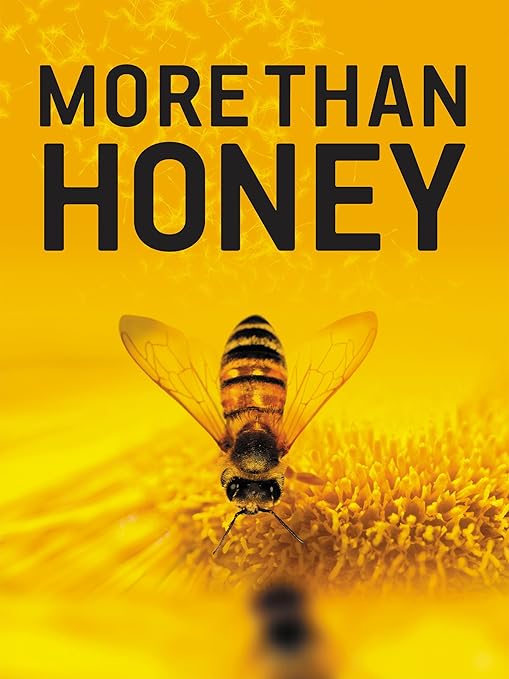
More Than Honey: A Review

More Than Honey

I just finished up watching More Than Honey. There are quite a few recent movies out there about bees and Colony Collapse Disorder (CCD), and this is the newest to top the list. Honestly, I wasn't super excited about watching this film, as I figured it would be more of the same. And while it did cover a lot of the same ideas as previous films, it gave things a nice new twist.
The cinematography is lovely and it includes some amazing close-up footage.  The film discusses the mating rituals and life cycles of bees, and emphasizes the fact that they work together as a super-organism, and not necessarily as individuals.
The film includes interviews with a variety of beekeepers, from pastoral to commercial, and the differences are astounding. Modern beekeeping has changed the process so much, treating these amazing creatures as if they were just another commodity to provide them with an income. We have lost respect for these insects that literally turn pollen into liquid gold.
One of my favorite parts of the film discussed the importance of bees to our entire agricultural system. They showed film from China, where many plants have to be pollinated by hand because there are no bees to pollinate for them. Seeing the workers standing on trees with a paintbrush of pollen, touching it to each blossom, was almost comical, yet also extremely sad. Humans are not efficient pollinators and our way of life is killing out the very backbone of our food base. Bees are literally the canary in the coal mine, announcing that our agricultural system in on the verge of collapse. And we seem to be doing very little to stop it.
The film also discusses CCD, but almost as a side note. The importance of bees to our food, and to our lives, is the forefront idea of the film. It stresses that CCD has been so mysterious because it is not one specific thing-- it's a combination of factors (pesticides, disease, stress) that is affecting the bees, and causing this incredible die-off that we are seeing.

Those of you who have read my blog in years past will know how much I love bees and love photographing them. I am not one to sit and be idle, ever really, yet I sometimes find myself sitting for 30 or 40 minutes at a time in my garden, simply staring at the bees. For me, it is a form of meditation, and I am looking forward to the coming days when bee-watching weather will be back. It's already just begun....

This film was lovely. I am going to show it to my class next term and I would love for you to watch it too. And then go watch some bees. It's a great way to soak it all in.

Pin It Now!

Monday, November 28, 2011

Vanishing of the Bees: A Review

I had a chance to watch Vanishing of the Bees over the weekend, and I loved it. I have read and seen quite a bit on Colony Collapse Disorder (CCD), but this film does a great job of putting it all together, and is the best I have seen on the subject as of yet. I am planning on showing it to my environmental science class next term.
The film goes into some details on what CCD is and how it has affected our agricultural system. Then the film dives into possible reasons behind this mysterious disorder.. and why most of them are likely not valid. The reason that the movie suggest to be the likely culprit is pesticides. But not the spray-on pesticides that have been used for generations. Instead, the problem is likely the new systemic pesticides which work from inside the plant.
These pesticides are not killing the bees on contact. And, in fact, that is what is so mysterious about this disorder. Very few dead bees are actually discovered. So, it's not like the fields were sprayed with pesticides which instantly killed many bees. That would be obvious. Instead, these bees are visiting plants with sub-lethal doses of systemic pesticides in them and bringing pollen (with systemic pesticides in it) back to the hive to feed the brood. The results are not immediate, but instead start to appear about 6 months later (during the winter), when the hive is relying on this stored pollen as its food source.
So it is not the pesticides that kill the bees directly. Instead, it is thought that these chemicals weaken their immune system and make them more susceptible to viruses, limited genetic variation or other problems that have been labeled as potential causes of CCD. The overall collapse of a hive may take several generations, which is why it is so difficult to show a precise link between these pesticides and bee deaths.
France had their own version of CCD happen there about 10 years ago, and after eventually figuring that it was linked to systemic pesticides, they were banned throughout the country and are now banned throughout many parts of Europe. Yet we are still using them in the US. With a vengeance.
The US follows an "innocent until proven guilty" method, where chemicals are usually approved for use unless it can be shown that they are dangerous. The problem with this is that the way this is regulated is that the EPA requires chemical companies to do their own tests to determine chemical safety. Hmmm, sounds fishy, right? So, if the pesticide company says it is safe, then it must be? Bayer, one of the makers of systemic pesticides, did test these chemicals on bees. But, they gave them high doses and watched them for 3 days. When they found no bee deaths, they deemed the pesticides to be safe. We now know that CCD happens over a longer period of time, and that it affects multiple generations (not just the bees who ingest the affected pollen). But Bayer says that they don't need to test that because no one is requiring them to. It's a crazy world that we live in.
To me, the most depressing aspect of all of this is that if bees that come into contact with systemic pesticides are seeing their entire civilizations die off within a generation or two, what is going to happen to the humans who are ingesting food with systemic pesticides? Are our children never going to be able to have children because of the affects of these chemicals? I think that we should take this as a warning. If the bees are suffering tremendous consequences from these systemic pesticides, don't you think we will as well? It may take a generation or two, which for humans is many many years, but if we wait that long to fix the problem, it will likely be too late. Let's save the bees and save ourselves. Pin It Now!

Monday, August 22, 2011

Colony: A Review

Colony is a movie about Colony Collapse Disorder (CCD), the mysterious unknown that is ravaging honeybees in the United Stated. I really enjoyed this documentary. It was much more focused on the social aspect of bee keeping, and how the industry is dealing with CCD, then on the science behind it, as I was expecting. The cinematography was beautiful and the entire movie had this backwoods surrealism to it. I almost felt like I was watching Napolean Dynamite, expect the people in the film were for real, and not just acting. I guess you have to be a little quirky to keep bees for a living, but the family that the film focused on was more than a little. But, I think that made me love them all the more.
Over the past few years, America has lost about 1/3 of its honeybees, and no one is quite sure why. There are theories from cell phone signals to genetically modified crops, and no one can seem to prove or disprove any of them. This movie went into a bit of detail on two of the main theories, pesticides and disease. Some scientists (and beekeepers) think that the cocktail of new and "ever-improving" insecticides may be killing off bees. The debate continues on this because dead bees are not found immediately after pesticides are sprayed or even in the spray area. Instead, bees are gathering nectar from these sprayed plants and bringing it back to the hive to feed the young. Some scientists are concerned that these sub-lethal doses are resulting in changes at the genetic level, causing birth defects one or two generations later. Additionally, some scientists speculate that these seemingly harmless doses could be causing memory loss and preventing bees from finding their way back to their hive. Other scientists (especially those that are employed by the chemical companies) think that these pesticides are completely safe for bees and pose no threat.
The second main theory is the disease theory. Bee populations are becoming more and more inbred as beekeepers are getting their queen bees from only a limited number of bee "breeders" (is that the right word? I have no idea...). This limited genetic diversity could be making bee populations more susceptible to disease. Whereas a population with lots of diversity will be likely to overcome most disease (with some dying off and some surviving), a genetically limited population who has no resistance to a disease will lose large numbers, and could potentially die off as a result.
Scientists and beekeepers are still struggling to discover the truth behind CCD. Whatever the cause, the film warns that humans should talk it as a warning sign, the canary in the coal mine if you will.....  If bees are suddenly dying off in large numbers due to some environmental factor, humans could be next if we don't change the route we are taking.
This movie is definitely worth a watch, if only to marvel at the life of beekeepers!

Pin It Now!

Saturday, June 26, 2010

Dear Bees....

Dear bees,

Thanks for all the hard work you do pollinating my garden!

Love,
Taryn Pin It Now!

Friday, March 26, 2010

Catch the Buzz: Mason Bees

Last weekend, my family and I hung our first mason bee tubes and we hope to start a little colony that lives outside our home. Before you declare me crazy, keep on reading! Mason bees are solitary bees native to North America (as opposed to what we normally think of when we picture a bee.. the European honey bee). They (sadly) do not produce honey like their European counterparts, but because of this, they do not need to be protective, and mason bees will only sting if they are stepped on or grabbed.
Now you may be asking yourself "if they don't produce honey, then what is so great about them?". Let me tell you! Mason bees are extremely important pollinators, especially now with honey bee populations on the decline. So, raising mason bees in your yard promotes pollination for your home-grown food!
This is my first time around with masons so I am still learning the ropes, but I have found my local nurseries to be a good source of mason bees, as well as information. You can purchase mason bee 'babies' in the mud-filled tubes shown above. After they hatch, they will be busy (as a bee) pollinating and creating a nest with next year's bees. So, you need some bee-filled tubes, and some empty tubes that can be used for nesting once the females hatch. You can simply drill 3/8-inch diameter holes (that are 3-6 inches deep) into a piece of wood or you can buy a tube system as is shown above. We went with the tube system as tubes are easily replaced each year, and bees need a fresh hole to nest in. Also, from the research I did, it seems this system is better at keeping out predators and fungal infection (presumably due to the cleanliness). Masons seem pretty low maintenance, and then main duty of the bee keeper is to switch out the used tubes each year.... seems like something I can handle.
I am excited for our masons to hatch and I am hoping some will choose to stick around and build nests for next year. If you are looking for a sting-free way to up your fruit yields, I encourage you to research more about our native buzzing friends. I have found the website of the WSU extension to be fairly informative, and any google search for "mason bees" will pull up plenty of results. Pin It Now!

Thursday, August 13, 2009

More Bees Please? Join the Great Sunflower Project!


Bees are some of our most important garden friends. While most people want to avoid bees (and their stingers) I am going to urge you to invite bees to share your garden. Bees are some of the most important pollinators (they pollinate 90% of our flowering crops) and without them, we would not have many of the fruits and vegetables that we enjoy. Without pollination, most plants do not reproduce, which means that they do not produce fruit.... and no fruit means nothing for us to eat.
In recent years, bee populations have been drastically declining..... and no one is sure exactly why. Maybe it is the over-abundance of pesticides, maybe it is genetically modified crops, maybe vast stretches of monoculture (think corn) or maybe it is cell phone use or a combination of these factors. Figuring out what is killing the bees could be vital in figuring out how to save them. And trust me, this is one bug we definitely want to save.
Want to do your part in saving bees? The best thing yo can do is plant a bee-loving habitat in your yard and invite the bees to come. To find out the best plants in your area to attract bees, consult your local nursery or do some research online. A great source for information is Berkley's Urban Bee Garden web page. They have loads of information of the importance of bees, bee-friendly gardens, and other random tidbits about these fuzzy little friends.
You can also join the Great Sunflower Project. Sign up online for next summer's planting. You will get a packet of sunflower seeds in the mail and you and thousands of other participants will be tracking bee activity in your yard. This way, scientists can have data on where bees are flourishing and where they are not, and can try and relate bee populations to environmental factors. You can be part of bee-saving research!
If you are bee-brave, you can also consider building bee habitat in your yard. Check with your local nursery to see what types of bees are native in your area and find out what habitat suits them. For many bees (not honeybees), a piece of wood with holes drilled in it works just fine. For those of you in the Portland area (or anywhere else that Mason bees are native) , check out this great information sheet on Mason Bees from Portland Nursery.
Bee Happy! Pin It Now!