{this moment} - A Friday ritual. A single photo - no words - capturing a moment from the week. A simple, special, extraordinary moment. A moment I want to pause, savor and remember. Inspired by Soulemama
Please check out Monday's post on Killing It With Kindness and help out if you can! Happy Weekend!
Pin It Now!
Mama Gone Green is a blog dedicated to raising happy children and reducing our impact on the Earth. My name is Taryn and I am the mother of 2 young kids and an environmental studies instructor at a community college in Portland, Oregon. Please join me as I journey through life as a mama, teacher, knitter, photographer, gardener, and environmentalist!
Friday, October 14, 2011
Thursday, October 13, 2011
One Straw Revolution: A Review
One Straw Revolution by Masanobu Fukuoka has been on my to-read list for a long time.... over 2 years. When I finally picked it up to read it, I wondered why on earth it had taken me so long. This book was captivating, easy to read, and was much more than I expected it to be.
One Straw Revolution is a book about natural farming. I was expecting it to be more of a hands-on technical type book (which are often slow reading), but in fact it was quite spiritual and philosophical. The author, Fukuoka, uses natural methods to farm his land in Japan. And by natural, he does not mean that he uses organic compost and fertilizer... he actually follows what nature would do, planting nitrogen-fixing legumes in rotation with his rice crops, and also putting the "waste" straw from his rice harvest back onto the field. He uses almost no added nutrients, does not compost, and does not worry about pests. His pests change from year to year, and his expectation are that he will lose a small portion of his yield to pests. Not fighting against the pests allows the natural cycle to take place, and rarely do losses from pests become large.
Fukuoka talks about how the modern system of agriculture is not sustainable, and how it is destroying our environment. He believes that one day we will all have to use his methods of natural farming because we will not have the resources left to continue our current farming practices. The most amazing thing about all of this is that this book was published in 1978, before anyone was really aware of the destruction that our agricultural methods were causing. I take that back, obviously some people, like Fukuoka were aware, but for most of us, the move away from conventional farming is just now starting to happen (and many people still don't have a clue how much damage modern agricultural practices are creating). However, this movement towards "organic" and "natural" farming here in the US is not what Fukuoka is talking about. Organic is obviously better than non-organic, but according to One Straw, it still causes environmental destruction and it wastes time and energy. Fukuoka laughs at how organic farmers take crop residues, compost them, and then return them to their field (I guess he is laughing at me because this is what I do!). The crop rotation he has going allows him to just leave residues on the fields, and he grows alternating sets of crops that are not affected by the pests of the last crop. So, by the time a crop gets rotated through again, any pests that would affect it have been long gone. It is a magical system, I must say.
Interspersed through all of this talk of farming is talk of the power of nature and the spiritual side of growing food and sustaining oneself, which makes the book seem much more poetic than simply a book about farming. The downsides to this book are, well, of course, I don't live in Japan and I am curious how the system he uses would work where I live with the crops that I eat.. it seems like such a simple set up, yet how simple would it be to recreate it here, with the crops that grow where I live? Also, the end of the book goes into this mini-rant about how food should be simple. How dinners don't need to be fancy, how we don't need seasonings, and how food should be enjoyed with its natural flavor. I do agree that over-seasoning something or over-processing things can really detract from the flavor as well as the health benefits, however, I love eating deliciously prepared and seasoned food. He says that salt is the only seasoning that should be used.... Why? Seasonings are herbs, which are also plants and they make food taste wonderful. So, he may be a master farmer but it sounds like his palette could use a little pick-me-up.
Anyways, this is a great read and one that I should have read long ago! Pin It Now!
Wednesday, October 12, 2011
Homesteading Disasters (Or I've Been Weeviled)
So, some of you may remember a post where I talked about dehydrating blueberries, and despite going way longer than the dehydrator instructions, I wasn't completely convinced they were dry. I had a great suggestion to put the dried blues in the freezer, in case they weren't 100% dry. But, sadly, by the time we got home from California, they had already started to mold. This almost brought tears to my eyes. Luckily though, since this was my first time using a dehydrator, I envisioned that something like this might happen. So I only dried about a pint of the blues and either froze or ate the rest fresh. So, at least I didn't lose my whole harvest and next time I will know that they need to go longer. Much longer.
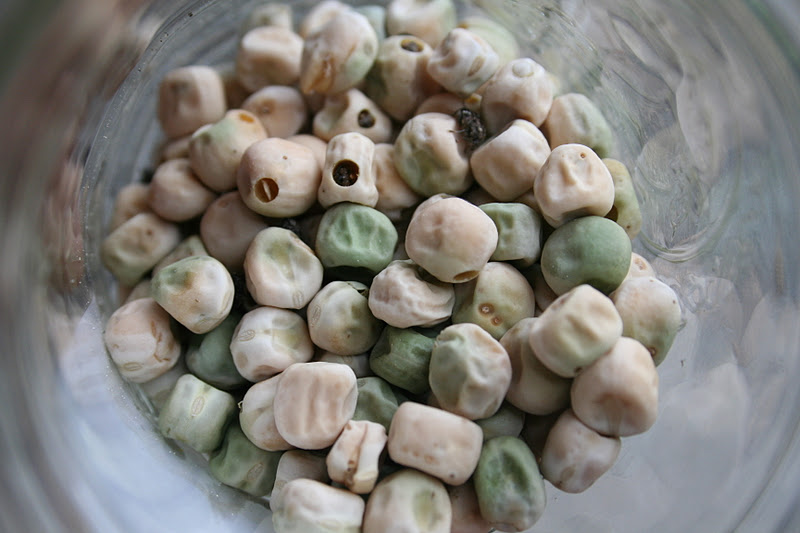
In other garden news, in August I posted about saving seeds from my pea plants. Well, yesterday I decided to check in on them and this is what I found:
Ewww, right? With a quick google search I found out that they are cowpea weevils, a type of beetle that eats pea seeds. Awesome. I guess I will be buying my pea seeds next year. They are pretty fascinating though, because you can see the holes where they ate their way out of the seed. My question is how the heck do I prevent the weevils from getting into my seeds? And was I eating them when I ate my fresh snap peas? Yikes. Anyone have any experience with these pesky guys? I am obviously going to toss these seeds, but I would like to be able to save (pest-free seeds) in the future. What am I doing wrong? Pin It Now!
Tuesday, October 11, 2011
Finn's Birthday Countdown
Finn will be turning 4 in a little less than a month! He has requested a pirate party (and he wants it outside, which is a little crazy for a November birthday in Portland) and preparations are officially underway! In order to give him a sense of how long until his birthday, I made him a birthday countdown. It's a buried treasure; each day he will remove a grain of sand and be one day closer to his special day!
Pin It Now!
Monday, October 10, 2011
Killing It With Kindness

My fabulous friend Wintry, who blogs at Mama Wintry, lost her sweet niece Tuesday in 2009 to a rare form of childhood cancer. Since her passing, her family has started whatchagonnado, an organization that raises money to help ease the burden of families who have a child struggling with cancer.
Whatchagonnado is teaming up with etsy sellers to raise money for their cause. Each month, one or more artists will be donating 20% of their sales to whatchgonnado. This month, my wonderful friend Heidi, who blogs at Under the Humble Moon, is donating sales from her etsy shop, Humble Luna. She makes fantastic dragon tails (just in time for Halloween!!) and other lovely children's items. I will be donating 20% of sales from my etsy shop during the month of February (don't worry, I will remind you all again then!!).
So, how can you help! First off, make sure to check out Humble Luna this month. Also, whatchagonnado is looking for more etsy artisans to commit to a month! If you have an etsy shop and would like to donate 20% of your sales for a month, please either let me or Wintry know. You would be helping a wonderful cause (and it is great free advertising for your shop!). Don't have an etsy shop but want to help? Spread the word! Feel free to grab the whatchagonnado button and put it on your blog! Share this post on your blog or on facebook! Ask your talented friends if they would like to join in to "kill it with kindness". The families they help will surely thank you for it! Pin It Now!
Saturday, October 8, 2011
Apple Picking
Fall has arrived and we have the apples to prove it. Today we headed to Hood River to pick apples and to enjoy a day of sunshine! We were also surprised by strawberries that were ready to pick...In October! So we picked, we ate, we conquered. I think I know what my next few days have in store..... I will keep you posted on what these apples get turned into!
Pin It Now!
Pin It Now!
Friday, October 7, 2011
Ivy Pullin'!
Today I brought my students out to do some volunteer work instead of the typical field trip we do on Friday mornings. We headed to a section of Forest Park (with an employee who works for the city of Portland there to lead us) and we helped to demolish as much english ivy as we could in an hour and a half.
English ivy is a terribly invasive species in Portland. It spreads by seeds and by roots, and the mild winters here allow it to thrive and continue growing all winter long. It is everywhere. We helped to restore a small part of the Forest Park ecosystem back to its native plants. It felt really good to spend my morning getting rid of a pile of the invasive ivy, and it made me want to make volunteering a more regular thing. I think Finn, who is almost 4, is probably old enough to come along on some volunteer adventures, and would probably learn a thing or two as well.
Do you have invasive species where you live? Do you and your family find time to volunteer? Pin It Now!
Subscribe to:
Posts (Atom)